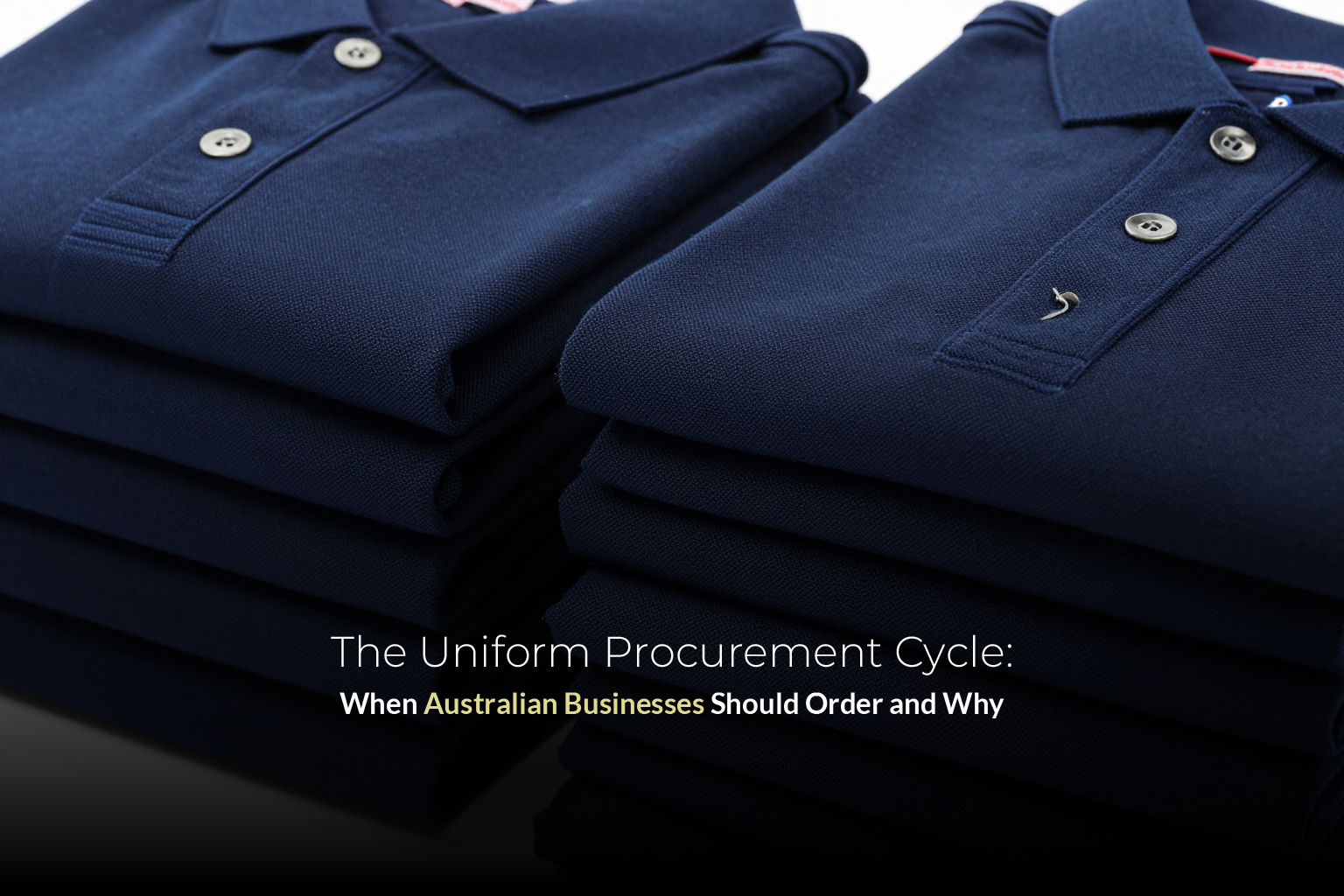
In the fast-moving world of Australian business, the clothes your team wears are often the first thing a customer notices. Whether it’s a high-vis polo on a construction site in Perth or a sharp blazer in a Sydney boardroom, uniforms do more than just meet a dress code—they act as a mobile billboard for your brand.
However, many business owners and office managers treat uniform ordering as an afterthought. This “reactive” approach—waiting until a staff member complains about a hole in their trousers or a new hire starts on Monday with nothing to wear—leads to high shipping costs, limited stock choices, and unnecessary stress. To stay ahead, you need to understand the Uniform Procurement Cycle.
Understanding the Australian “Uniform Calendar”
Australia has unique seasonal shifts and fiscal deadlines that dictate when you should be placing your orders. Operating on a cycle allows you to align your spending with tax benefits while ensuring your team is never caught in the wrong gear when the weather turns.
Quarter 1 (January – March): The New Year Reset
The beginning of the year is often the busiest for many industries, particularly retail, trades, and education. While you might be tempted to wait, Q1 is the best time for a Total Inventory Audit.
- The Goal: Identify what survived the previous year and what needs replacing.
- Strategy: Place “Top-up” orders for core summer items (short-sleeve polos, breathable work shorts) to get through the tail end of the heat.
Quarter 2 (April – June): The Winter Transition and EOFY
This is arguably the most critical period in the procurement cycle. As the temperature drops, demand for jackets, hoodies, and knitwear spikes across the country.
- The Timing: You should be ordering winter gear in April or early May. If you wait until June, you’ll likely find that popular sizes in heavy-duty jackets or softshell vests are out of stock nationwide.
- The Tax Benefit: Ordering before June 30 allows you to claim these expenses in the current financial year. Under Australian Taxation Office (ATO) guidelines, compulsory uniforms with a permanent logo are generally tax-deductible for the business.
Did you know? According to the Australian Taxation Office (ATO), for a uniform to be tax-deductible, it must be “distinctive”—meaning it has a permanently attached logo and is not available for public purchase as “everyday” clothing. Plain black trousers or white shirts without a logo typically don’t qualify, even if they are required for work.
Quarter 3 (July – September): Spring Prep and Large Projects
Once the new financial year kicks off, it’s time to look toward the warmer months. Spring in Australia can be unpredictable, making this the perfect time for “Trans-seasonal” ordering.
- Strategy: Focus on layering. Vests and long-sleeve cotton shirts are ideal for the transition.
- The Big Picture: If your business has large contracts starting in the summer, Q3 is the time to negotiate bulk pricing with your supplier to lock in rates before the end-of-year rush.
Quarter 4 (October – December): The Summer Rush and “The Christmas Cut-off”
The final quarter is the “danger zone” for procurement. Between Black Friday sales and the looming Christmas shutdown, freight networks become heavily congested.
- The Deadline: Most Australian uniform decorators (embroidery and screen printing) have a “cut-off” date in mid-November. If your order isn’t in by then, you likely won’t see it until late January.
- Action: Order your summer high-vis gear, branded caps, and light-weight polos no later than October.
Why Strategy Beats Spontaneity
Planning your orders 3 to 6 months in advance isn’t just about being organised; it’s about the bottom line. Let’s look at the “Why” behind a structured procurement cycle.
1. Navigating Lead Times
Customising a garment isn’t as simple as picking a shirt off a rack. The process involves several steps:
-
Stock Arrival: 1–3 business days.
-
Artwork Approval: 1–2 days.
-
Production (Embroidery/Printing): 7–14 business days.
-
Shipping: 2–7 days depending on your location (longer for regional WA or QLD).
Total lead times for a branded order usually sit between 10 to 21 business days. During peak periods like June or December, this can easily double.
2. Cost Efficiency and Bulk Discounts
Buying ten shirts every month is significantly more expensive than buying 120 shirts once a year. Most suppliers offer tiered pricing. By consolidating your needs into two main annual orders (Summer and Winter), you save on the “per unit” cost and drastically reduce your annual freight spend.
3. Maintaining Brand Consistency
Dye lots can change. If you order small batches frequently, you might find that the “Navy” shirt you bought in March is a slightly different shade than the one you bought in September. Large, cycled orders ensure your entire team looks uniform in the truest sense of the word.
The Environmental Factor: Reducing Textile Waste
In 2026, sustainability is no longer optional for Australian businesses. The “throwaway” culture of cheap, low-quality workwear is being replaced by a focus on durability and responsible disposal.
- Quality over Quantity: A higher-quality cotton polo might cost $5 more upfront, but if it lasts 18 months instead of 6, you’ve reduced your procurement frequency and your environmental footprint.
- End-of-Life Planning: When uniforms reach the end of their cycle, don’t just toss them in the red bin.
Did you know? Australians throw away approximately 229,000 tonnes of textiles and clothing into landfill every year. To combat this, many Australian businesses are now partnering with textile recovery services like Seamless or BlockTexx to shred old branded uniforms into raw materials for use in tiles, insulation, or even new fabrics.
Implementation: How to Build Your Cycle
Ready to move away from “emergency” ordering? Follow these three steps to build a cycle that works for your specific business.
Step 1: The “Buffer” Stock Rule
Never order exactly the number of shirts you need for your current staff. Always maintain a 15% buffer. This ensures that if a seam rips or a new staff member joins, they can be branded and ready on Day 1. Use your Q1 audit to replenish this buffer.
Step 2: Use Online Portals
Many modern suppliers offer client portals where your approved designs and previous orders are saved. This removes the “back and forth” of artwork approvals and allows for “Two-Click” reordering. If you aren’t using a portal, you are wasting administrative hours.
Step 3: Establish a “Uniform Policy”
A clear policy helps staff understand how often they are entitled to new gear (e.g., 5 shirts and 2 pairs of trousers per year). This makes your procurement forecasting much more accurate because you can predict exactly when your team will be “due” for their next set.
Summary Table: The Ideal Ordering Window
|
Season |
Order Placed |
Best For… |
Why? |
|
Winter |
April – May |
Jackets, Knits, Hoodies |
Beat the cold and use EOFY budget. |
|
Spring |
July – August |
Vests, Long-sleeve Polos |
Prepare for “Four Seasons in One Day” weather. |
|
Summer |
September – Oct |
Caps, Shorts, Light Polos |
Beat the Christmas factory shutdowns. |
|
New Year |
Jan – Feb |
Full Inventory Audit |
Refresh brand and prepare for the year ahead. |
Conclusion
The Uniform Procurement Cycle is about shifting your perspective from “buying clothes” to “managing an asset.” By understanding the Australian seasonal calendar and the logistical realities of embroidery and freight, you can save your business thousands of dollars and ensure your team is always comfortable and professional.
Take a look at your current stock levels today. If your team is still wearing their summer gear and the mornings are starting to get crisp, your winter window is already closing.